

Research · Practice · Learning
The challenge of these times is to remember what change is.
What does transformation actually require?
The Center for Regenerative Change is a research-practice organisation exploring how people, institutions, and places undergo deep and regenerative transformation.
We bring together systems thinking, depth psychology, organisational research, ecology, anthropology, and decolonial thought to investigate a question that sits beneath many of the crises and change efforts of our time:
How can transformation restore capacity, relationship, and responsibility rather than reproduce depletion, extraction, and control?
What
we know
Transformation is everywhere.
But what do we mean by it?
Businesses launch transformation programmes. Governments pursue sustainable transitions. Communities seek regeneration.
People are asked to adapt continuously to new technologies, structures, and crises.
Yet much of what is called transformation changes processes without changing the relationships beneath them. New strategies are introduced while old assumptions about power, value, growth, responsibility, and human development remain intact.
The problem may not be that we lack another change framework.
It may be that transformation itself remains insufficiently understood.
The Center for Regenerative Change studies transformation as a phenomenon in its own right: what initiates it, what it asks of those moving through it, how institutions shape it, and what allows change to become regenerative rather than extractive, imposed, or merely cosmetic.
-
What does change actually require – beneath the frameworks and the jargon?
What would organisations look like if they grew the capabilities of people instead of consuming them?
How do we move from extraction to reciprocity – in practice, not just in principle?
How do we build businesses and institutions that nourish the places, communities, and futures in which they are rooted?
Featured
research
Working Paper No. 1
The Forgotten Theory of Transformation
Towards a relational foundation for regenerative change
Transformation has become a defining ambition across business, government, education, sustainability, and community development. Yet the phenomenon itself remains conceptually unclear.
This first paper in the Center for Regenerative Change Working Paper Series explores what established traditions of organisational change, systems thinking, developmental psychology, regenerative practice, and decolonial thought help us understand, and asks what may still be missing.
Its central proposition is that institutions do not merely implement change or produce outcomes. They also shape the people who participate in them: their agency, identity, responsibilities, relationships, and capacity to act.
Status: In development
Publication: 2026
The Regenerative Change
Working Paper Series
The Working Paper Series develops the Center’s inquiry one question at a time. Each paper makes a bounded contribution to a larger research programme and is published to invite dialogue, criticism, and refinement.
01 — The Missing Theory of Transformation
Why does transformation remain difficult despite decades of research and practice in organisational change, leadership, and systems thinking?
02 — The Soul of Change
What can initiation, developmental psychology, and lived experiences of crisis teach us about the inner movement of transformation?
03 — Institutions Make People
How do institutions shape identity, agency, obligation, belonging, and responsibility?
04 — The Theory of Relational Transformation (ToRT)
How might the relationship between an institution and the people it transforms be studied systematically?
05 — From Passage to Place
How do personal, institutional, ecological, and place-based transformation interact?
These titles and questions are provisional. The programme will evolve as the research encounters criticism, evidence, practice, and its own limitations.
"Profit-maximisation functions as an invisible environmental designer: it structures the spatial, temporal, and institutional conditions through which people live, work, learn, and relate."
— Adina-Iuliana Deacu, When Business Shapes Minds and Cities (RIFS, 2026)
THE WHEEL
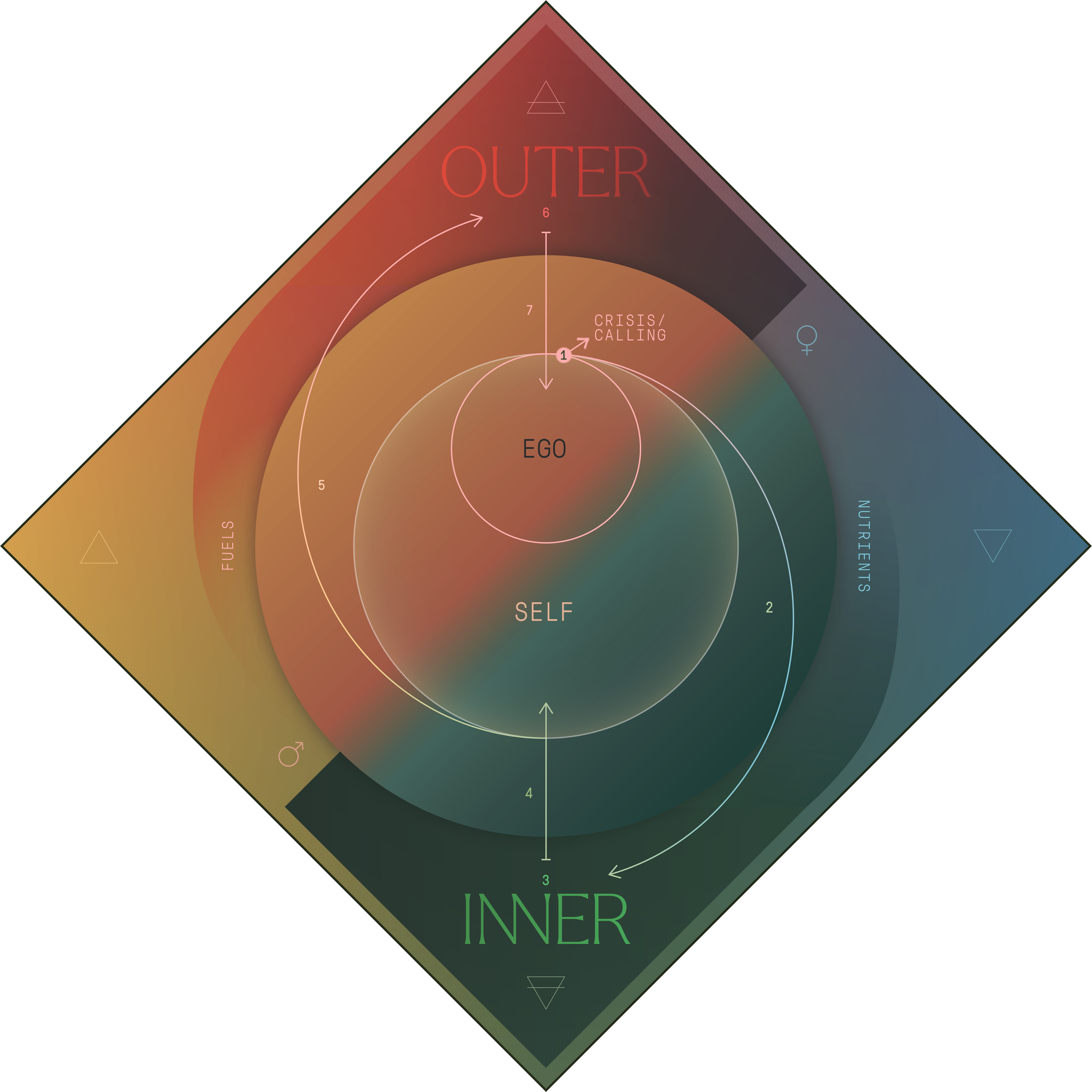
The Soul of Change
Most people navigate change without knowing change is asking of them.
At the heart of the Center's work is the Soul of Change, a wheel that always turns in our lives. In large circles or small ones. The Soul of Change helps understand how genuine transformation unfolds.
The crisis or calling interrupts an old pattern, the descent is a leap into the Unknown, the rebirth asks for patience and presence, and the return brings our discoveries into the world.
This is not theory. It is a map of something people move through whether they have language for it or not. The Center works with this map at every scale, with individuals, with organisations, and with communities navigating threshold and renewal.
"Regenerative Change is the practice of restoring life-giving relationships, within ourselves, between people, within organizations, and between human systems and the living world."
— David Hoogland, founder of the Center for Regenerative Change
Organisational transformation has a persistently poor track record. McKinsey continues to estimate that roughly 70% of transformation efforts fail to achieve their intended objectives.
Who is this for
This work is for people who are serious about change that goes to the root.
Not cosmetic improvement. Not the next iteration of approaches that have already been tried. The work of the Center is demanding — of the people and organisations who undertake it, and of us. It asks something genuine. In return, it offers something most frameworks do not: a way of understanding and navigating transformation that leaves capacity, not depletion, in its wake.
The Center works with founders, leaders, change makers, regenerative practitioners, researchers interested in or navigating periods of threshold and redesign. With organisations and institutions that want to become genuine places of development for their people, their communities, and the places they inhabit. With practitioners who need a deeper framework than standard consulting or coaching can provide. And with communities working to regenerate the life of a specific place.